
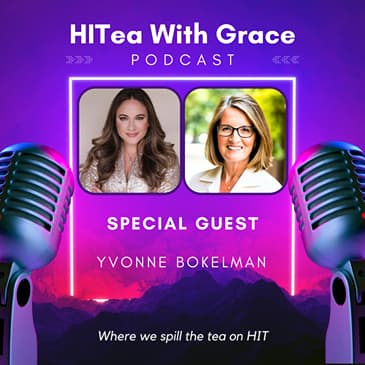
Pour yourself a cup, because this one is full of insider insight! On HITea With Grace, where we spill the tea on HIT, Grace sits down with Yvonne Bokelman, Executive Director and Advisory Board Co-Chair of MedtechWOMEN.
Yvonne has seen healthcare from just about every angle: hospital administration, health IT, consulting, global leadership at Medtronic and Zimmer Biomet, and startup CEO at Alyve Medical. She shares what each role taught her and what surprised her most about trading a big company for a startup.
We also get the scoop from MedtechVISION 2026 and its theme, "The Breakthrough Imperative: Winning in an Ever-Changing Landscape," including:
- The biggest pressure on medtech leaders right now: AI, reimbursement or capital discipline
- Where AI is helping patients, and where the hype is getting ahead of reality
- What sets apart the companies that are still getting funded
- The biggest opportunities for women leaders in medtech
Plus, Yvonne previews what's next for MedtechWOMEN and MedtechVISION 2027, shares her advice for women in healthcare and health IT, and tells us all about her tea and the story behind her mug!
Subscribe to HITea With Grace for more conversations with the women shaking up healthcare IT. Cheers!
[00:00:04] Welcome to HITea With Grace, where we spill the tea on HIT. Today, I'm honored to welcome to the pod Yvonne Backelman, Medtech Women's Executive Director and Advisory Board Co-Chair. Thanks for joining me today, Yvonne. Thanks so much, Grace. Glad to be here. So tell me a little bit about the career path that brought you to Medtech Women. Yeah, it's actually a little bit of a pivot, but it builds on literally the foundation of my whole time in healthcare.
[00:00:29] My whole career has been in healthcare. I started on the provider side in hospital administration, kind of moved into healthcare IT, consulting. And then for the last couple of decades, start to age myself, I've been in the med device space, working for some big players like Medtronic, Zimmer Biomet, where I spent most of my time, a number of years, ending there as president and GM.
[00:00:53] And then I decided I wanted to try the startup space. And so I've been doing some advisory work for a company and became CEO as I left Zimmer. And that was a great experience. I probably want to touch on that a little bit later. And then after a few years of that, and that's a tough life as CEO of a startup, I stepped away and began to entertain kind of what now has become a portfolio career of doing some board work, some private equity advising and the opportunity presented for Medtech Women.
[00:01:22] And what the organization stands for in terms of trying to create enhanced visibility for women and really support women in the Medtech sector is just really near and dear to my heart, having grown up kind of in that spine ortho space that's pretty male dominated. So it's been great to be here and to be doing what we're doing. And yeah, that's kind of how I got here. I love it. That's fantastic.
[00:01:49] Now, what did seeing health care from the provider and IT side teach you that you still use in Medtech and in the work that you're doing today? Yeah, it really, it turned out, as most of my career has a little serendipity, it turned out to be really valuable in that I always have the perspective of the patient kind of first and foremost. And who is the customer and how do they operate and how is, what is the reality of how health care is going to be delivered?
[00:02:17] You create a device, you create a new therapy, a new process. How is it really going to fit in to that provider, to that physician's practice, to the hospital setting, to the ambulatory surgery center setting? And so having had all of those experiences really has been helpful and a good point of reflection for me and for me to advise others on what we need to do and how we need to put things together. Yeah, that makes a ton of sense.
[00:02:42] How is running a startup, you mentioned that and the challenges it brought, different from leading a global business at a company the size of Zimmer Biomet? Did anything really surprise you? Yeah, there were definitely some surprises. It's different. It's right. So it's really in a big company, you've got, generally speaking, you've got resources. You certainly have infrastructure. Things take a while, but the pace is just different. In a startup, it's scrappy. It's decisions are very impactful.
[00:03:12] They change very quickly. There are not resources. And so you're trying to do a lot, but you have very little support in doing it where in a larger company, it's different. So it's really managing the complexity or managing the scarcity is kind of how you would differentiate them. I think for me, the learning or the surprise was how I worked in those settings. And what I came to realize, well, I like the ownership of a startup. I like the pace.
[00:03:42] I probably wasn't excelling on the things that I thought I could do best, which was build big teams, launch products, get out there and support a larger organization. And at least in the startup I was with, there just wasn't an opportunity to do that. We never got the kind of full funding to make that happen. So the surprise was more a learning and a progression for me more than maybe an understanding of how they worked. I think I had a good appreciation for that.
[00:04:08] So interesting having all of the experience that you have had that now culminate into MedTech Vision. And so I want to talk about MedTech Vision. The theme this year was the breakthrough imperative, winning in an ever-changing landscape. What did you hear in the room that really stuck with you at the conference this year? Yeah. So for those that aren't familiar, MedTech Vision is kind of our premier annual in-person event for MedTech Women.
[00:04:36] And it's been going on since 2011. So there's a lot of history there. And each year, more excitement, more building. This year, I think, gosh, there were several takeaways, several comments, what I observed, what was the communication I got, the feedback I got. And it started from, we always start our event off with a patient keynote. And in this case, we had a very interesting patient keynote who was also a physician. So she had seen both sides of things and had some really adverse circumstances.
[00:05:06] But her messaging is, what's possible? Think about what is possible. And that message kind of wove through the entire day. When you're thinking about the pace and the change that is just the constant in MedTech. And then how do you be successful? And what are your strategies to be successful? And how do you execute in that environment? And then thinking of this backdrop of what's possible. What can you make happen? We talked about volatility and how to really be strategic and get past that.
[00:05:36] We talked about AI and how that's being successfully utilized in companies. We had a executive interview. This year, it was Martha Aronson, the CEO of Merit Medical. And she had some great feedback. One was reminding everybody to always ask the question, who should be in the room? Let's make sure we're involving the right people to get to a good decision that's going to benefit everyone. And we will have thought it through.
[00:06:03] And I think that really resonated with a lot of folks in the audience, a lot of the women. And then for me, she said something that has always sort of been something I've taken away, which was she's had this great career progression and all these opportunities. And it was that she always said yes. Like this crazy stuff comes to you and you think, I can't do that. Or I don't know anything about that. But say yes. And that's how I have done in my career.
[00:06:30] I've taken on some things that I would have never imagined I would be doing or would have done. And it just leads to one more thing. And as long as you're clear about what you know and what you don't know, and you get help where you need it, I think you can do anything. And so her message was kind of along that line as well. And I know that resonated as well. I love that you are inspiring the leader in addition to talking about trends in the space.
[00:06:58] I think that often gets overlooked when you're talking about a wide variety of things that are impacting everybody, but also to see the person, the leader behind all of the trends and to inspire them to say yes, to dream big, to go and make an impact is amazing to hear. And also really encouraging, inspiring. And I know we are grateful, just my listeners are probably grateful just hearing it from you too, like what was said and how it was done.
[00:07:27] And that said, what were some of the trends like that you were hearing about the space that people were talking about, whether it's in the hallways or on the panels or in the room there? Yeah. So it covers the gamut depending on the size of the company. We have startups. We've got strategics. We've got early stage. We've got late stage companies in the spaces. And so all of them have a little bit different priorities. And I am always happy that we can feed all of those, that we've got a message that works for everyone.
[00:07:58] AI was definitely big and reimbursement was big. And I was really happy to see that. After I finished just talking with you in about an hour, we are going to have a webinar in MedTech Women that's called Reimbursement is the Business Model. And really talking about, you've got to be thinking about that all the time. So that's always a topic. Being able to have sort of the financial discipline to be successful,
[00:08:26] the prioritization that needs to now happen is really key. So you heard discussions around that as well. Site of service, that shift to the ambulatory surgery center was another big topic where we looked at a couple of companies who've been in that space and how they're being successful. And I think that really also was pretty an interesting topic that our audience wanted to know more about.
[00:08:53] What do you think is the biggest pressure on MedTech leaders right now, especially after having just thrown this amazing conference that people really learned a lot from and then also got to brain trust with others like them? What was the pressure that people were talking about? I think financial pressure is always there. I think MedTech companies are always trying to figure out where to place their bets, what they need to do.
[00:09:20] And that may mean some really great programs don't get funded or supported in the way that some may want. So that always is a constant. And there's this geopolitical macro environment that's changing that you don't necessarily have control over. So how do you link in with that? And that was kind of the volatility discussion. How can you be effective? Where do you keep looking? Where's the North Star as you can move through things?
[00:09:46] So those were definitely pressure areas or are pressure areas that I know our community is looking at and dealing with as they're moving through. Again, anything and everything AI. We talked about there's AI in the product and then there's AI that I think is probably more impactful at this moment, which is AI through efficiency tools. Like how do you make your quality, legal, regulatory, clinical, those kind of systems,
[00:10:15] where are there opportunities to incorporate AI? In healthcare, it was this balance and it was talked about like, you can't remove that human component. We just can't. And so how do you have the best of that and yet the opportunity that AI represents? And it may not always be in your actual device or your implant or your software, although there's a lot going on in the digital and software space.
[00:10:39] But it can do a lot of background work that really supports and helps organizations be a little leaner and free up some money and do those things. So lots of discussion around that. Do you feel that the AI discussions were fearful at all? Because I've heard a lot in the news in the past few weeks, past month, talking about, oh, AI, doomsday. Do you feel that it was more fearful or more cautiously hopeful? I would say cautiously hopeful.
[00:11:07] And in fact, when we opened up the panel, it was like, has everybody seen the newspaper? We've got the companies coming out saying doom and gloom, as you just said. And what do we think? I think fear people have is being behind. Like, oh my gosh, we're not moving quick enough. We don't know. But I think that pace has to be tempered with everything else that's going on. And do you really want to be the number one way out there chasing to the edge of the cliff?
[00:11:35] Or do you need to be the fast follower that's kind of implementing once you've got some good intelligence about how things are working and what the pros and cons might be? But I think it was definitely optimism about the opportunity that it could represent while approaching that in a very thoughtful way. With capital getting tighter, what separates the companies that are still getting funded from those that are really having challenges? Yeah. I mean, there can be lots of individual reasons.
[00:12:03] I think if you look at it, 30,000 foot view, it really is those companies that have more than a cool, interesting device, but they really have a credible business. They can easily demonstrate that they have a regulatory pathway, a reimbursement pathway, that they have a path to commercialization.
[00:12:24] I think the pacing of getting money and the length of time before there might be an outcome for a startup are getting really stretched out. And so knowing when you start a company that you may have to take it all the way is really important. So knowing that, hey, we have sales and they're in this area and here's what we can show and here's the market.
[00:12:46] I think that path to commercialization and executing on it is really helping those find money and continue to get money. And knowing that, where do you see the biggest opportunity for women leaders in medtech over the next few years? I mean, not even just with capital, but just in advancing in general. There's a ton of opportunity. There's a lot of data and I don't have it at my fingertips to quote today, but we haven't made the progress with women leadership in medtech as we would like to be.
[00:13:15] It's been a lot of progress, but it's still not enough. And particularly at kind of go director level and above, and it just gets tougher and tougher. So I think the opportunities are really to look at situations where women can really be sitting at the table where the decisions are made and just not participating in those decisions, but really influencing them, influencing investments, influencing all decisions, influencing board activity.
[00:13:40] And so being able to shape the future of companies, I think is where we want to be. And that can take all kinds of stuff. I don't want it to sound like, oh my gosh, I've got to have like a CXX position to be able to make that happen. In a startup or a smaller company, there's a lot more opportunity to be impactful at different levels of the organization because you're just, you're smaller, you're leaner and you're meaner. And then I think being heard in organizations, making your wishes known that you want to have a seat at the table
[00:14:10] and what does it take to get there? I know that's a question I specifically asked a manager that I had earlier in my career. What is it take and how can I get there? Because you know the importance of that. So I think that's the opportunity women have is to really keep pushing to have that seat at the table and to be the influencer for their company. I love that. Now what's next for MedTech Women? And what should people expect from MedTech Vision 2027? Yeah, so we're super excited.
[00:14:39] And it's one of those things, there's so much work that goes into planning these events. And again, we're a small 501c3, so it's not, we're more like a startup. There's not a lot of those big company resources to make it happen, although our sponsors are really who support us and help make it happen. So we're going to continue to grow. We're going to continue our national presence. We're going to continue to push out content and networking opportunities and more opportunities for women to be visible.
[00:15:08] But we've already started the debriefs. We're already starting the planning for 2027. We're going to be in a slightly, well, different location that will allow us to be slightly bigger. We've been sold out for a number of years, and this year was no exception. And we want to be able to, we don't want this huge, massive meeting. That's sort of not our vibe for this. We do want to grow. And so 2027 is going to allow us to grow,
[00:15:34] which will allow us to expand hopefully our content and our offerings and what we're doing. And again, continue to meet what I hear from members that they want, that opportunity to learn more, to connect, to network, to be in person with other female leaders and share and gain from expertise. Just love it. That is amazing. And I can't wait to cheer you on in that process and share along as you continue this amazing journey. Now, while my listeners love to hear about trends in the space
[00:16:03] and people who are moving minds and moving industry innovation, they also love to learn from amazing leaders like yourself about what drives you. So what are some things that you do in your day-to-day that help you work your best to make a difference? I am, so it's a self-reflection question. I'm really, for me, and particularly in this space, I'm at a point in my career, I'm doing things that I really love or that are of keen interest to me. And that just makes such a difference in your approach,
[00:16:33] your ability to listen and be empathetic and help others. And that's really kind of where I want to be and what I want to do is how can, in this case, MedTech Women be an organization that really supports you and what do we need to do? So, and doing that is incredibly humbling. As I walk off of MedTech Vision and look at all the LinkedIn activity and traffic that you see
[00:16:59] and all the posts, it's just, I'm just blown away by the impact that has. And so I want to keep doing that. That feeds me and makes me feel successful and also happens to drive the organization. So it's kind of a win-win across the board. So yeah, I'm a little bit of a workaholic. I really go for it, but I really want to meet the needs of the community that we support. And that's kind of how I do it. I see you. I am too. Both of us are.
[00:17:28] So you're in the right room. Yeah. If you could give your younger self a piece of advice, what would you tell her? Oh gosh. I think it would be, I think I finally got there on some of it, but it would have been to think about it earlier to sort of kind of stand your ground. And I mean that in an appropriate sense, but stay true to yourselves, who you are, what you want, be authentic. Don't get put into positions that are not fun or uncomfortable or those kinds of things.
[00:17:56] And ask the question, if you have an idea of where you want to be, find those that can help you, that can sponsor and mentor you and help you grow into that. And I think, I feel like now I could have always done that sooner or earlier in the career. And like I said, I think I got there, but would have loved to have done it a little smoother and better earlier on. Yeah, I like that. I do. So to finish this conversation off right, where can our listeners find you online?
[00:18:26] So I am usually on LinkedIn, either directly through MedTechWomen or through my own, through me. Or again, anybody can reach me at any time with MedTechWomen, either through our MTW at MedTechWomen.org or Yvonne Backelman at MedTechWomen.org. Excellent. Now, before I forget, did you happen to bring tea with you today or a mug with coffee? And that's amazing. So you have a nice Yeti mug. What I love about those mugs is they stay hot all day long.
[00:18:55] I know. I do too. I am a big hot tea drinker. And I am very fortunate that my husband is an early riser. He comes down, makes two of these for me. So I have two Yeti mugs. And so I am able to get through the whole morning with really hot tea. And I'm so appreciative of that. So yeah, cheers to this. Cheers to that. Well, thank you so much for joining me today, Yvonne. It was great to have you. Thanks, Grace. I really appreciate the time. And thanks to you folks for joining us too.
[00:19:24] Check out the Hi Tea with Grace podcast for more interviews with great guests like Yvonne today. Cheers. Like a Girl Media is more than a media network. It's a community. We want to meet you and amplify your voice and the voices of outstanding women innovating in healthcare. Interested in starting your own podcast or hosting an event near you? Connect with us online or in person. We're here to support and empower you. We're here to support and empower you.