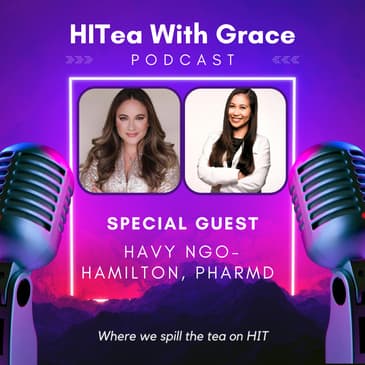
In this special episode of HITea, Grace sits down with Havy Ngo-Hamilton, PharmD, a pharmacy innovation leader at Buzz Health, to unpack what’s really happening between the moment a prescription is written and when a patient actually gets their medication.
Havy brings a front-line perspective on where the prescription journey breaks down most—whether it’s access barriers, affordability challenges, or friction at the pharmacy counter. Together, they dig into how cost isn’t just a financial issue, but a major driver of medication adherence, and why “price transparency” often falls short of what patients actually need at the point of care. This conversation goes beyond buzzwords to explore what meaningful transparency and better patient experiences should really look like.
They also take a closer look at prescription savings models and digital platforms, separating what simply raises awareness from what truly improves outcomes. From the role health systems should play to the innovations worth paying attention to, this episode highlights why medication affordability is a system-wide issue—not just a pharmacy problem.
As always, the conversation closes with a more personal note, as Havy shares what drives her, how she navigates challenges, and her advice for women building careers in healthcare and health IT. It’s a thoughtful, practical, and refreshingly honest discussion—served with a side of tea, of course.
[00:00:04] Welcome to HIT with Grace, where we spill the tea on HIT. Today, I'm honored to welcome to the pod, Havy Ngo-Hamilton, a fantastic pharmacy innovation leader at BuzzHealth. Thanks for joining me, Havy. Hi, Grace. Thank you so much for having me. So great to learn from you today. So tell me about the career path that brought you to your role. So currently, I'm the Senior Pharmacy Director at BuzzHealth, previously BuzzRx.
[00:00:28] So with my role, I oversee the clinical accuracy and timeliness of our educational healthcare content. But now that we expand into as BuzzHealth, we shift from more of a consumer-facing platform into a more B2B focus. So I serve as a subject matter expert in the healthcare technology space. So we focus on pair dynamic and then emerging healthcare regulations and things like that.
[00:00:56] Interestingly, my background is actually in internal medicine. I'm a hospital clinical pharmacist where I cover all the medical surgical floors for all the adult patients and also the intensive care unit. So when I talk to people and I tell them where I've been and where I am today, the reaction is almost like, wow, that's such a drastic transition. And it is. But you know, at the end of the day, I think the most important things is that as a healthcare professional, as a pharmacist,
[00:01:24] patient education is so crucial. And I think what I do today with BuzzHealth, BuzzRx is very vital. And more importantly, my personal mission aligned closely with BuzzHealth, which is to expand health equity and patient access by ensuring medication affordability and healthcare equity for everyone. I love it. That is so cool.
[00:01:47] So as this PharmD boss woman, where do you see the prescription journey breaking down most often between the moment a medication is prescribed and the moment a patient tries to pick it up? From selecting the most appropriate medication for a patient to the point that somebody tried to pick it up at the pickup counter at the pharmacy, I think the breakdown point would be like medication pricing, right?
[00:02:13] So if somebody, I can choose the best medication that is best for their condition, like that is like the safest, the most effective, the most appropriate. But if you cannot for the medication, then what is the point? I was looking up some studies the other day and I found that up to 58% of US adults do not take the medication as prescribed due to cost. That's more than half. That is a lot.
[00:02:38] So I think like high medication pricing definitely play a part in non-adherence. And I think another part that is not often talked about is sticker shop, like which is like the surprise at the counter. I mean, sure, if the medication is too expensive and you cannot afford it, obviously that would affect adherence. But I think also like the phenomenon of you showing up at the pharmacy counter and then you hear like you are informed about the price.
[00:03:06] And I think that also would lead to a lot of abandonment of therapy too. So both of those are also like, are two different aspects that would play into non-adherence with medications. As a patient advocate, I worked with a number of patients and caregivers that have said exactly what you just said. Like, yeah, it's great. They have this wonderful treatment option for me, but like, can I afford it? And sometimes it is that sticker shock that just makes them want to not do it at all.
[00:03:33] Because, oh, I'm caught off guard now. Like, why isn't insurance covering this? Why isn't just free for me or whatever else? So I think you're right. It's really a challenge for patients. And you've really spent kind of your career at the intersection of pharmacy and patient access. How do affordability challenges show up as real adherence problems for ongoing treatments? Interestingly, I mean, I don't think anybody would just like not take the medication intentionally. Or, I mean, there are people who would tell me,
[00:04:03] I don't want to take this medication, but mostly it would be due to side effects. Like, oh, this medication affect my sleep. This medication affect my appetite. So I don't want to take this medication. So like what I would do is that we'll talk about alternative, right? But really they like know it is really rare that somebody would say, I cannot afford this medication, so I'm not taking it. And usually like we would pick up unsigned as like late refills, skipping refills,
[00:04:31] and then ultimately disease progression, rehospitalization. And so like when we're looking to those signs and like we can just pick up that, oh, this person might not be taking their medication as prescribed. So obviously when we talk about medication pricing and affordability, we think about that as a financial issues. And it is, but to me, in my perspective, it's also a clinical one too. Absolutely. Very underrated.
[00:04:58] And it should be seen as a hindrance to integrated care overall. There's a lot of discussion around this price transparency in healthcare and what you've been talking about. From your perspective, what does meaningful transparency really look like at the point of care to help prevent some of these challenges that you just discussed? To me, I think routine pricing is a key here. So first, both patient and the provider should have access to the actual out-of-pocket cost,
[00:05:25] not just an estimate, but a reliable figure that can truly guide the decision-making process. Second, in my opinion, transparency should be seamlessly integrated into the clinical workflow. And so like, for example, when a provider prescribes a medication, they should be able to see like the lower cost alternative, like or call risk restriction or prior authorization or step therapy, instead of like discovering that after the prescriptions are being sent in and get rejected at the pharmacy.
[00:05:56] When looking at prescription savings models and discount platforms, what separates something that drives awareness from something that truly improves, from something that truly improves the patient experience? And can you tell me a little bit about these savings models and like, why don't people know about them? And how are they integrated with you guys? Yeah, I think so. You heard about BuzzFix. Like we provide prescription discount modality to patients. And I really think BuzzFix paved the way for pricing transparency
[00:06:24] by allowing patient to compare prescription prices across different pharmacy chains, right? And I think that is very impactful and it really drives awareness. But when you think about it, like now that we expand as BuzzFix health and being the affordable intelligence layer, I think the bigger opportunity is actually upstream in the prescription journey, right? And that's why I think what would truly improve the patient experience would be like we offer our X-Compare marketplace,
[00:06:52] which I create multiple pricing options into one place to offer the best pricing. And then we also have smart bin technology that allow automatic routing that can be saved into the patient's profile to continue to offering the best price every single time. There is just so much friction that is built into the system. And I feel like, yes, what we do with BuzzFix is very impactful. It drives awareness and it's great. But I think if we always step in at the end,
[00:07:23] we're really just helping patient to navigate a broken system, a broken process. So I know that we talk about price transparency constantly, but at the end of the day, if the provider cannot see a patient's real financial responsibility, I think that's definitely would not improve the patient experience overall. You've been having a lot of conversations now with health systems talking about medication affordability and how critical it is for them to figure out this challenge.
[00:07:49] What innovations are they kind of looking into first to start solving the challenges their patients face? And then what innovations do you feel like down the road, they'll be adopting even more so? I think, like I mentioned earlier, I feel like non-adherence and medication pricing is not only a financial issue, but also a clinical one. So definitely health systems should prioritize medication affordability because it would direct impact patient outcomes, right?
[00:08:18] So like when a patient is unable to afford the medication, like they would delay fill, they would skip dose, they would take a lower dose and prescribe. That would lead to hospitalization, disease progressions, and also like increase the overall healthcare costs. So it's definitely a critical clinical and operational concern for health system. Now, while my listeners love to learn about trends in the industry, thank you so much for sharing about price transparency and the future of pharmacy innovation in healthcare.
[00:08:47] They also love to learn from women leaders about you and like what drives you as amazing person that you are. So what are things that you do in your personal life that help you work your best and make a difference? I think you are a career woman and you're like obviously like working woman. I just feel like there is not enough time in a day to do, to exercise, to take care, like for your routine skincare, like to work and complete all your projects and like cookings and cleanings and everything.
[00:09:16] So for me, I think at the end of the day, if I can just sit here and work for like 10, 12, 14 hours and it'll be that day after days. So to me, I think like having a set schedule and try to stick to it to make sure that you have a balance, like work-life balance, like that is very important and definitely find something that you enjoy and do. And I feel like when I have this conversation with friends or other people, it's always like, well, I don't have time. I mean, you just have to make time for it.
[00:09:45] And I think, like I say, I can sit here and just work for 12, 14 hours and the work is still not going to be done. So find something that you enjoy. I love to crochet and knit. I love to cook. I love to read books. So like, I definitely, I cook three, four times a week and to a lot of people, that's a lot, but that's also time for me to decompress while I listen to audio book. So definitely balance, balance your life, like make sure that you have a good balance between your work and your life, like take care of yourself. Great advice.
[00:10:15] It's like you can't pour from an empty cup. And so you have to pursue hobbies. You have to pursue your health so that you can be a great worker, but also a great friend and a great sister and a great person in humanity. So I really love that advice. A lot of challenges come our way in life. It's just inevitable, right? Obstacles come our way that try to really cut us down. What are some things that you've done to stay resilient when those things happen to you, whether career-wise or personal-wise?
[00:10:44] I don't share this often or quite frankly, like I don't really share this because to me is pretty personal, but at the same time, I think this is what you do here is amazing. It's a great platform to motivate like all the individuals who are in healthcare or in like the IT space that you like want to, maybe like this would motivate someone. But I just want to share that you know, like I have lupus. I have two kidney transplant.
[00:11:10] And there are times that when I was hospitalized or when I'm not feeling well, it's definitely hindering like my self-image, like my motivation. But at the end of the day, I feel like you just have to have hope and like hanging on to what matters to you. Is that your family? Is that your pet? Like for me, like I know at the end of the day, what I'm looking forward to is my family, my husband, my pet. So that's what keep me going through my challenges and obstacles in life, whether that's not my
[00:11:39] health challenges or work challenges or other things in life, because life is hard. So yeah, thank you so much for sharing that with us. And I do it does encourage us because guys, all of us have something we're working through, whether it's a health challenge or a personal challenge. And it's not about life being perfect. It's about making the life that you have perfect for you, right? And just pursuing health and being well. Thank you for sharing that.
[00:12:06] And I'm wondering, as we kind of close this episode out, do you have any advice for women leaders looking to get into healthcare, health IT? I think it is definitely a male dominant film. And like, if this is what you are passionate about, if this is what like drive you like, and you would think that you would enjoy like doing, I feel like like definitely go for it. You know, that saying that say, oh, if you enjoy what you do, work a day in your life, you're still going to be working. You should be working, but you really enjoy.
[00:12:37] I mean, I feel very grateful. I love what I do at BuzzHealth. I think what we do is very impactful. Like to me, to be able to use what I've learned in school and throughout my training and use that and apply into like product design that would have like real world impact. It means so much to me. And to me, like, that's what keeps me going. And to all the like, to everybody out there, I feel like like if you have something that you are interested, definitely go for it.
[00:13:05] Because at the end of the day, if you go into a field that you don't enjoy going to it for the wrong reason, definitely every day will be a struggle. Like both my husband and I are in healthcare. And I feel like social media and like TV shows like Grace Anatomy just make healthcare look a lot more like just fancy and it's just like glamorous. It's not. It's very stressful. It's a long day. It's draining physically and emotionally.
[00:13:33] But, you know, at the end of the day, being able to take care of patients is means a lot to us. And I feel like choose something that you're passionate about and go for it. To finish this conversation off right, where can our listeners find you online? Well, they can find me on LinkedIn with my name, Harvey Ngoe Hamilton PharmD. And so we can connect to learn more about each other and everything that I do at BuzzHealth. That's terrific. Now, before I forget, did you happen to bring tea with you today? Or coffee?
[00:14:01] And if so, tell me about your mug. So this is rather an inexpensive mug. My husband got me. He always said every time if I forget like onion, cilantro, I would ask him to stop by the grocery store. And every time he'd go to the grocery store, he always come back with like a surprise either for me or the dolls or the cat. So this is just like from the grocery store. And it's a inhale, exhale. And I think I also love the color. It's lilac. I think it's pretty. And to me, just to...
[00:14:31] He knows me really well. So it's just a reminder. You know, like just to take a moment and inhale and exhale throughout the day. Because sometimes I would be working for hours and I just feel like I'm just like holding in my breath. And so this is also a reminder for me to breathe in, breathe out, stay grounded, stay focused and take a moment for yourself. Beautiful reminder. Thank you so much for joining us today. It's been awesome to learn from you. Thank you so much, Grace, for having me. This has been very amazing.
[00:15:00] I really appreciate the opportunity to be here today. And thanks to you folks for joining us too. Check out the High Tea with Grace podcast for more interviews with great guests like Javi today. Cheers. Like a Girl Media is more than a media network. It's a community. We want to meet you and amplify your voice and the voices of outstanding women innovating in healthcare. Interested in starting your own podcast or hosting an event near you? Connect with us online or in person. We're here to support and empower you.