
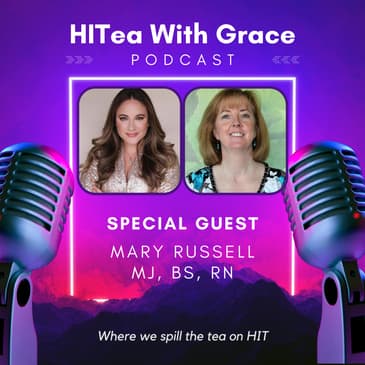
In this episode of HITea, we're honored to have Mary Russell, MJ, BS, RN, a retired Navy Nurse Corps officer and the Senior Director for Clinical Implementation at CliniComp, join us for an insightful conversation.
Mary shares her incredible journey from starting as a registered nurse to becoming a leader in healthcare IT. She delves into her motivations for transitioning into this field and how her extensive experience in both inpatient and outpatient military environments has shaped her approach to healthcare and clinical implementation.
We explore pressing topics such as veterans' mental health, current statistics, and concerns, and how technology is being leveraged to address these issues. Mary provides concrete examples of how technology is enhancing mental health services for veterans and other patient populations.
Mary also dove into the topic of disaster recovery and the critical role of EHR systems in maintaining healthcare operations during events like the recent devastating tornadoes in the Midwest. She shares real-life experiences from her career, illustrating the crucial role of disaster preparedness and EHR systems in ensuring patient care continuity.
And of course, no HITea With Grace episode would be complete without our signature tea moment! Listen in to learn from and laugh with Mary!
[00:00:00] Welcome to the HITea With Grace podcast where we spill the tea on HIT. I'm honored to welcome
[00:00:06] Mary Russell, a retired Navy nurse and senior director for clinical implementation at Clinikon.
[00:00:12] Thanks for joining us today, Mary. Thank you, Grace. I'm so happy to be here.
[00:00:16] And we're so happy to learn from you today. So let's start by having you share with us
[00:00:21] your journey from starting as a registered nurse to becoming, you know, to joining the Navy
[00:00:27] and becoming the senior director for clinical implementation. So what motivated you to transition
[00:00:33] into health care? I want to hear all about it. Tell me about your whole life.
[00:00:36] Okay, well, I will try to be interesting. So I actually I have been a nurse for a very long
[00:00:43] time. I am a well seasoned nurse. I started graduated from college back in 1987 as a
[00:00:52] registered nurse with my bachelor's degree. And in the 80s, nursing jobs were plentiful.
[00:00:59] There was no shortage. You could go to any hospital and get hired. You would have multiple
[00:01:06] offers out the door. So one lovely day there was this very sweet Navy Nurse Corps recruiter
[00:01:14] at the college. And after a somewhat brief conversation, I signed up for the Navy.
[00:01:20] And so upon graduation, I entered the Navy Nurse Corps and had some great assignments
[00:01:28] as an active duty young brand new nurse. It is in the Navy, there's an expectation not only
[00:01:35] that you will be clinically excellent, but that you will develop as a leader as well.
[00:01:41] And so right from graduation, they put you on that track and provide mentorship and direct
[00:01:48] mentorship, which you know, I think we've lost a little love today. And so it was a great time.
[00:01:54] I met my husband, I got married, you know, all those things you do, and got out of active
[00:02:00] duty service in 1991. And then I worked at local hospitals, I had a few different jobs,
[00:02:08] I worked on a surgical care unit with a great team of nurses. I loved that job. I
[00:02:14] loved those people. They were fabulous. And then I went back for my master's degree.
[00:02:21] And then the Navy actually gave me a letter and said, Hey, you're going to have to resign your
[00:02:27] commission as an officer in the Navy Nurse Corps, or you're going to have to start drilling
[00:02:32] as a reservist. So yeah, I was like, I kind of loved that career for me as the Navy nurse,
[00:02:41] and I loved the actual clinical nursing that I had done too. So I thought it would be the
[00:02:47] best of both worlds. And so I rejoined as a reserve nurse. And of course, the world went
[00:02:55] a little crazy, right after that 9 11, and then just years and years and years of war.
[00:03:04] And so I had a number of recalls to care for the wounded veterans at the National Naval Medical
[00:03:12] Center in Bethesda, which is now the Walter Reed National Medical Center. And we were inundated
[00:03:20] with casualties. So it was an amazing time, but again, with an amazing group of people who
[00:03:27] worked together to do our best under difficult circumstances. And that was stateside.
[00:03:34] So all of these things came together, right, the early nursing experience and leadership,
[00:03:39] and then being put into these difficult situations with these combat veterans. And then
[00:03:45] ultimately I got sent to the front in Afghanistan in 2009 into 2010. So
[00:03:54] it was all of that experience what had set me up for that experience there.
[00:04:01] And then when I came back, though, I was, I was a little burned out of direct patient care.
[00:04:09] So a friend of mine who actually works with me now called me and said, Hey, Mary clinic
[00:04:14] comes hiring for clinical analysts. I really think you should take this job. You would be
[00:04:20] really good at it. And we need you and, you know, come join us. So but I live in Philadelphia
[00:04:26] outside of Philadelphia and clinic comp is based in San Diego. So yeah, I really wasn't sure what
[00:04:32] that was going to look like. But I did. And I've been with planet com for 14 years
[00:04:39] from a clinical analyst now to the senior director of our clinical team.
[00:04:43] And it's been a great journey along the way. And I stayed in the reserves until 2019 I retired.
[00:04:53] But the nice thing about that was I had two careers, I had clinic comp career,
[00:05:00] and I had the Navy career and the Navy requires you as a nurse to actually maintain your
[00:05:06] clinical skill set. So I was still able to provide bedside nursing care up until 2018
[00:05:15] with the Navy. So so I really loved I really have had the best of all worlds.
[00:05:21] Oh, my goodness. What a background. Right? Thank you for your service. Thank you for all
[00:05:26] the time dedicated to our country to, you know, our to the US. I mean, you're amazing,
[00:05:32] Mary. I'm so inspired by you, you know, and having served as a Navy nurse for
[00:05:37] in both inpatient and outpatient planetary environment. How did those experiences shape
[00:05:42] your approach to health care and clinical implementation? Yeah, I think that you have
[00:05:47] to when I went to nursing school, it was driven into us that you have to view the patient
[00:05:56] holistically, that this moment in time with a disease process is not only impacting their
[00:06:04] physical health, but all aspects of their life. I think that training combined with the
[00:06:10] inpatient outpatient, I also was fortunate enough to be on the US and as comfort,
[00:06:16] which is the hospital ship and go to countries like Haiti and Nicaragua and really provide
[00:06:26] care in very austere environments. And even here in the States, you need to understand from the
[00:06:31] outpatient side, what resources does this person have? What kind of support? What's their
[00:06:38] diagnosis? You know, are they going to need psychological support, spiritual support for end
[00:06:43] of life, all of those considerations. And I think that framework has helped me to ensure
[00:06:52] that every day in our job, we advocate for all of the staff who are using our products
[00:07:00] in the field and then all of the downstream impact that has on a patient. And are they
[00:07:08] able to look at the whole picture inpatient or outpatient? So interesting to think about it
[00:07:14] even more holistically given that experience you had, we hear a lot about veteran mental health
[00:07:19] challenges, you know, and that being a missing piece in a lot of this. Can you kind of provide
[00:07:24] an example of how, you know, are there any facts and concerns talking about veteran mental
[00:07:30] health that could speak to and how our healthcare organizations kind of leveraging
[00:07:34] technology to try to help address some issues and that whole person care thought process
[00:07:40] and issue? Yeah, obviously it is it remains a big topic, you know, veterans are still 1.5
[00:07:48] times higher risk to commit suicide. And an alarming statistic for me is that when you break
[00:07:57] that down and look at male versus female, female veterans are 2.5 times higher suicide,
[00:08:05] successful suicide, which is shocking to me in so many ways. And I think that speaks to
[00:08:12] all of the difficulties that they encounter on a daily basis. What you know, whether they're
[00:08:19] deployed or stateside, the stresses of leaving your home, leaving your family, you know,
[00:08:25] how well are they supported? What experiences are they having? Obviously this generation
[00:08:32] that is serving now, they are the post 9-11 young people, right? And they have grown up
[00:08:40] in a world full of strife and stress. And I think that we have to keep adapting
[00:08:47] to their mental health needs, you know, things like gender identity, and how does that equate
[00:08:55] to military service? Where do I bunk? How do I dress? Where, you know, all of those things,
[00:09:01] I think we didn't have to deal with those as right as openly. And this generation is,
[00:09:09] they are very well equipped, I think, to speak about their mental health concerns. You know,
[00:09:17] they talk a lot about their anxieties and things. And I think that Veterans Health and
[00:09:24] really so many companies and corporations are trying to leverage technology to empower them
[00:09:32] with tools at their hands, with mobile applications, things that will let them do
[00:09:39] mental health self-assessments as well as coaching, PTSD coaches. All of these are apps.
[00:09:48] And this generation, that's all they know. They grew up with phones, right? Grace,
[00:09:53] you're... Oh, I know. Yeah, we can all know what we call them and understanding that we can use an
[00:09:58] app to help us with XYZ and honestly stay using it. And we want it to look good. We want it to
[00:10:05] be easy to use, right? As long as we add that, we'll use it. So I think that's interesting
[00:10:11] that you say that that is a huge part of this, is that this next generation is ready for that.
[00:10:16] Maybe it will help a lot. Yeah, I'm optimistic. I really hope so. I hope that, you know, that
[00:10:23] they can tap into that. I think that there's young people, you know, think of Veterans,
[00:10:30] the VA as old peoples, you know, that's where the old people go. And that's just not true.
[00:10:37] They're incorporating more and more women's health as part of their specialties. And
[00:10:42] really, they have grown with the times and prepared for the next generation as they've
[00:10:47] done successfully through other generations in the past. Yeah, it's so interesting to me,
[00:10:53] you know, you went from nurse to better, you know, to nurse for the Navy, and then you went
[00:10:59] to a healthcare informatics leader. So I'm interested, what advice would you give to nurses
[00:11:05] now who are interested in transitioning into nurse in the Navy? And then who might also
[00:11:10] then be interested in transitioning into healthcare informatics? I love to hear,
[00:11:13] you know, advice from each of those steps that you feel might be particularly helpful or valuable.
[00:11:19] Do you find that there are skills or experiences that are valuable in each of those different
[00:11:23] steps that you've taken in your journey? Yeah, I think that obviously, I think number one,
[00:11:29] stay clinically adept, whether that's actual hands on nursing practice, or whether it's
[00:11:36] through conferences and continuing education and things like that. You have to know you have to
[00:11:42] be abreast of what the best practices are, because they're always evolving. And you have
[00:11:48] to understand that if you've been away, know where you need to make sure that your skill
[00:11:54] set is up to par. Take advantage of mentors. I am the age group that we're all retiring now
[00:12:02] from the bedside. If you're a clinical nurse at the bedside, you need to take advantage of
[00:12:07] the mentors who are there and have clinical experience. I think that if you want to transition
[00:12:15] to informatics, you need to first learn your system. What electronic system are you charting
[00:12:22] with? What do you use? Understand it deeper, become a super user, work on implementations,
[00:12:28] be an early adopter, be somebody that's going to drive workflows that will optimize your daily
[00:12:36] experience. You can do that right now in your current position. And then if you want to move
[00:12:43] to the informatics world, make sure you're actually really good with computers.
[00:12:47] Make sure that you learn and develop processes and workflows and how to implement a system
[00:12:56] training, things like that. Very interesting. Yeah, with all important
[00:13:01] thoughts to think about. And if you're a nurse looking to get in, get that mentor,
[00:13:05] stay on top of your game, no technology. It's going to be critical for whatever next step
[00:13:10] you take, whether you better your career as a nurse or you decide to change your career.
[00:13:14] And like Mary did, have multiple careers at once with the nurse. That's pretty fantastic.
[00:13:19] So I want to tap now into your clinical implementation brain because I've been hearing
[00:13:25] in the news a lot about all of these tornadoes going through the Midwest.
[00:13:30] Insane, nonstop, not to mention the interruptions of service and security attacks.
[00:13:36] I want to dive in with you about the importance of disaster recovery and the role that
[00:13:41] the intersystem can play to ensure that there's no downtime during these huge events where
[00:13:46] healthcare is needed more than ever. And so let's dive a little bit into this topic.
[00:13:51] I want to hear a little bit about just different strategies you do or respond through
[00:13:58] in relation to this whole idea of clinical implementation and
[00:14:02] clinical ongoing ability to keep going during disasters happening.
[00:14:07] Yeah, it's one thing to implement a system at a hospital or a clinic or wherever you're
[00:14:14] working. But if that system goes down or even if it has scheduled downtime,
[00:14:22] those things are so disruptive to the continuity of care for your patients.
[00:14:28] And so where I work at Clinic Comp, we have a near zero downtime for 40 years.
[00:14:36] It's unheard of and our company has been through those disasters with our customers
[00:14:43] literally around the world. The tsunami in Japan, when that hit we had hospitals there and we
[00:14:52] at Clinic Comp, everybody all hands on deck, we're going to migrate these records and make
[00:14:57] sure that as they evacuate everyone, they have access to their critical health information.
[00:15:04] Because the problem is that a tornado blows in or a flood or a tsunami,
[00:15:10] those things don't wash away your chronic and critical health care needs.
[00:15:17] They exacerbate them. It's a very stressful situation to be going through not to mention
[00:15:22] potentially looking for home, to work. It's just a nightmare.
[00:15:29] Right. Yeah, exactly. And so being cognizant of that, having experience with that,
[00:15:36] certainly at 9-11, we were at a hospital in New York City and our system was one of the only
[00:15:44] things still running. When they had no thing else, they were still able to triage and move
[00:15:51] all of those critical workers and employees, everybody that was impacted by that.
[00:15:57] And then you have Hurricane Sandy. Again, I'm an East Coast person so these things were
[00:16:03] directly in my lifetime.
[00:16:05] Me too, I'm an East Coast girl and all these things impacted my life significantly.
[00:16:09] I can't imagine just with the VHR system how many lives it impacts if it ever
[00:16:18] goes down. You know what I mean? I can't even calculate in my brain how many people
[00:16:21] would be impacted by that.
[00:16:23] Yeah, right. I mean millions of records online, millions of staff and patients.
[00:16:29] You really need to be able to maintain that continuity of care, especially as you said,
[00:16:34] under the most difficult of circumstances. And if you can't get to the data or the information,
[00:16:41] as you said, it's just going to exacerbate the patient's condition and anxieties and
[00:16:46] it's just terrible.
[00:16:50] What is the secret sauce to disaster recovery? Making sure that you stay alive
[00:16:56] in your clinical systems during things like this? What keeps people going and keeps the
[00:17:02] system going?
[00:17:02] Well, I think planning. I think a system architecture that is adaptable and is
[00:17:10] well integrated into the seamless medical record keeping system, one that's mobile,
[00:17:18] one that is sustainable, is just critical. If your infrastructure is not sound, if your
[00:17:25] architecture is just in, then when these events hit, there's nowhere for you to go.
[00:17:32] You cannot move forward for the patients who need you and the nurses and the providers
[00:17:38] and everybody without that underlying sustainable system.
[00:17:43] Very interesting. Thank you for sharing that experience and just the knowledge that you all
[00:17:50] gave for your four years doing it. It's pretty impressive. I'm wondering, how do you see
[00:17:56] the role of health IT evolving in the next five years, 10 years, particularly in relation to
[00:18:02] patient care and disaster recovery and clinical systems?
[00:18:05] Honestly, I think that the current progression in health care and in health IT is already
[00:18:13] ramping up. It has been, especially in the last 10 years that I have seen. I've been with
[00:18:18] Clinicom for 14 years and in this clinical analyst, director roles now.
[00:18:24] I think that we've come, when I started nursing, we were on paper.
[00:18:31] We've come a long way from you wanting to do research to try to come up with a solution
[00:18:37] for a problem. You were sitting and sifting through paper records trying to find that needle
[00:18:43] stack. It was labor intensive, it was long in duration, but now everything is electronic. That
[00:18:50] data is queryable and at your fingertips at any given time. I think that the data scientists
[00:18:56] and the researchers and all of the people involved in AI are going to be able to take
[00:19:04] that data and exponentially move us forward in the next five to 10 years,
[00:19:10] whereas it might have taken us time to get all the data and then to understand how to analyze
[00:19:15] it and then what to do with it. I think everybody that's working in health IT needs to be
[00:19:21] prepared for rapid integration of changes in the way that we manage patients
[00:19:29] and the way that we document on those patients and the way we analyze that data
[00:19:34] and change best practices consistently. That's a great perspective and it's inspiring.
[00:19:39] As a patient and caregiver, I always think about these things. You look at the system
[00:19:44] and it feels like there's no hope because there's so much broken. When you hear about
[00:19:49] innovation and ideas and people like yourself that are leading the way to make changes so
[00:19:54] it's better, you can't help but have an optimistic outlook. Like, wow, Mary's on it. We're good.
[00:20:03] Then I am good. It puts a face to the name of the innovators that are solving the problems.
[00:20:09] I want to encourage our listeners today. I want to know your stories. People need to hear
[00:20:14] your stories of how you're innovating in space. People don't have to hear them because
[00:20:18] it's hope and life-giving. A space that really lacks. Mary, I want to learn more about you.
[00:20:25] You have done so much in your life and have built such a beautiful career. What are things
[00:20:31] that you do as a leader to work your best and make the difference? Are there habits you have
[00:20:36] in your day to day or things that you do to just keep you on your feet? I think that
[00:20:41] yeah, the totality of my experiences have hopefully helped me to be a compassionate leader.
[00:20:51] I think that family first is my mantra with the folks who work for me. That comes first
[00:20:59] and foremost. If they don't feel that things are stable or steady or comforting at home,
[00:21:08] they're not going to work well for me. You have to listen to people. I like to talk, obviously,
[00:21:16] but you have to be a listener. Learning from me, learning the generational changes
[00:21:24] in communication styles, in wants and needs and desires from a career perspective,
[00:21:31] it's not like mine. They have different life goals and ambitions and quality of life.
[00:21:39] I think we can all learn from that. This job is taxing. It's travel. It's a significant amount
[00:21:47] of travel. You really, really need all the support to stay healthy as a family, healthy
[00:21:54] as an individual, healthy as an employee. From my perspective, I want to make sure that everybody
[00:22:01] always fully secured it and not micromanaged. I trust my staff. They're fabulous, smart,
[00:22:10] intelligent people. I learn from them every day. You don't have to know everything as a
[00:22:15] leader. First of all, you shouldn't think you do. If you think you do, that's a bad thing.
[00:22:22] Just take a second and continue to learn and grow, but support, support, support your team.
[00:22:29] Such solid advice, Mary. I appreciate sharing that with us. If you could give your younger
[00:22:34] self a piece of advice, if you could go back and say, see young Mary, just starting or like,
[00:22:41] what's that piece of advice? Grace, that's a great question.
[00:22:46] That was a hard one because it's deep in there. I'm sure there's so much advice, but yeah.
[00:22:55] Because I certainly never saw my career going the way that it did. Not at all. I was born
[00:23:02] and raised in a blue collar neighborhood. Lots of immigrant families, hard working.
[00:23:08] And I went to Catholic school for 16 years. I was taught by the nuns. So hard work and
[00:23:15] discipline were really entrenched in my life. I value those skills, but I think what I would
[00:23:24] say and I think my children would probably agree is I would tell myself, you don't have to work
[00:23:31] that hard. Don't work so hard. Good things will come, but be satisfied. Sometimes it's okay to
[00:23:40] just be satisfied with where you are. I have a tendency to be a little ambitious and I worked
[00:23:49] more than I probably needed to at times. So I think that's what I would tell myself.
[00:23:55] I love it. Take a break listeners. Take a break. Yeah, take a minute. Drink a cup of tea.
[00:24:04] So to finish this conversation off right, where can our listeners best find you on?
[00:24:08] I am on LinkedIn and I think that's probably the easiest place. I've done other bylines and
[00:24:14] interviews and things there. And so you'll often find CliniComp posting my other thoughts and
[00:24:20] ideas about health IT. Terrific. Now before I forget, did you happen to bring tea with
[00:24:25] you today? Drinking tea. Although I drank it the whole time. You chatted the whole time.
[00:24:30] It's cold, I like to talk. Tell me. That's what I love. We want that. We want to learn from you.
[00:24:36] So tell us about your mug or your tea. I would love to hear about it.
[00:24:40] No, yes. This little mug was a gift from my mom. And again, I'm Irish. So I was raised
[00:24:49] drinking tea and I love tea. I love everything about tea. So this is English breakfast tea.
[00:24:55] I will either English breakfast or Irish breakfast. And I just love everybody should
[00:25:00] drink tea, I think because it really starts your day off just right. Right?
[00:25:07] You have to put the kettle on. It takes time for the kettle to boil. Love that sound of
[00:25:12] the whistle. And then you put the tea and you have to let the tea steep. So you do that. So I
[00:25:19] think it just really starts your day. I love the pace of it and eases me into my day. And
[00:25:25] then by the bottom of the cup, I'm full of caffeine and ready to go.
[00:25:30] Even just hearing you talk about the process of making and drinking the tea is comforting.
[00:25:36] We're actually doing it. So that's too good. Thank you so much, Mary, for joining us today.
[00:25:41] Love learning from you. Thank you for the opportunity, Grace. Great to meet you.
[00:25:45] Congratulations to you on all your success. And I can't wait to see how your career continues
[00:25:52] to grow and develop also. Oh, truly appreciate that. Thank you. And thanks to you folks for
[00:25:58] joining us too. Check out the Hi Tea with Grace podcast website for more interviews
[00:26:02] with amazing guests like Mary today. Cheers. Cheers.