
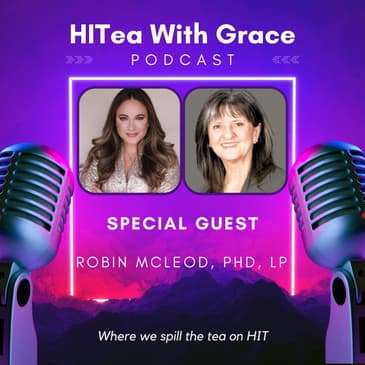
In this episode of HITea, Grace Vinton welcomes Robin McLeod, PhD, LP, CEO of the National Society of Autism Professionals (NSAP), clinical psychologist, and systems-level leader whose career has spanned clinical practice, executive leadership, and field-wide transformation.
Dr. McLeod is building something the autism field has never had: a unified professional home for the multidisciplinary community of clinicians, educators, researchers, advocates, and support professionals working across the autism ecosystem.
Together, Grace and Dr. McLeod explore what NSAP is and why it was needed, why the autism field has long operated in silos and why now is the right moment to change that, how NSAP plans to integrate the voices of autistic individuals and their families, and what it will take to bridge the persistent gap between research and real-world implementation. They also tackle the increasingly polarized conversation around autism care philosophies and how the field can move toward more collaborative, evidence-informed dialogue.
Join us for a candid conversation about community, innovation, and the future of autism care.
Connect with Dr. Robin McLeod: https://www.linkedin.com/in/rmcleodphd/ Learn more about NSAP: https://www.catalight.org/press-release/national-society-of-autism-professionals-nsap-launches-to-create-a-unified-voice-to-move-the-field-forward
Listen, subscribe, and stay connected with HITea With Grace for more conversations with healthcare leaders making a difference. Cheers! ☕
[00:00:04] Welcome to HITea With Grace, where we spill the tea on HIT. Today, I'm honored to welcome to the pod, Dr. Julie Wood. She's a PhD and she's CEO of the National Society of Autism Professionals. Thanks for joining me today, Robin. Thank you for having me here. So tell me about the career path that brought you to your role today.
[00:00:24] It wasn't really a straight path, but I'm a psychologist. I'm also the mom of an autistic young adult. So when I was trained as a psychologist, it was at a time when they didn't train psychologists in general about autism, not very much. So we came out of graduate school really only having an image of autism as what you might see in the movie Rain Man. Did my practice and as I was building what was started as my solo practice, our son was diagnosed with autism.
[00:00:52] And that I really didn't know much about it at that time. So I started attending all kinds of CE events so that I could learn. I was trying to get services for him and it was a time when services weren't widely available. And because I had a practice that was growing into a multidisciplinary clinic, I started hiring people who could provide those services in our community. And so I'm hiring people and I'm doing these trainings and they eventually talked me into making that my specialty.
[00:01:19] So for most of my clinical career, autism has been the focus of my work. So amazing. I just love that. My youngest son actually has ADHD. And so I'm very grateful. He's young. So we have a lot of amazing resources now. But I'm so grateful for the work that you and your organization is doing. So tell me a little bit more about your career path. Yeah. So I built my practice by the time I left that practice and left as a practicing psychologist about three years ago,
[00:01:47] because as my clinic grew and as my son became more independent, I started getting involved in what I call psychology politics. So I became the chair of the Minnesota Psych Association, which led me to become the chair of our licensure board and got into APA governance roles as a leader and eventually got recruited at a time when I was open to leaving practice to join the staff at the American Psychological Association.
[00:02:14] And it was there that my portfolio was uniting psychologists across the country through their state psychological associations, bringing people together to develop guidelines for professional practice and forming relationships with external organizations in psychology, really becoming someone whose portfolio included guiding leaders of leaders in psychology. Absolutely incredible. We are so lucky to learn from you. Oh, my goodness.
[00:02:44] So for those of us hearing about NSAP for the first time, that's the National Society of Autism Professionals. What is its goal and out of the gate and also down the road? What are some of the things you're working on? I just am so grateful for you at the helm of this organization and at the work that you're doing to advance policy and more in this area. Yeah, well, so NSAP is what we call it.
[00:03:08] So NSAP is a professional association and it's designed to unify all of the professionals whose work is focused on the lives, the rights and outcomes of autistic individuals and their families across the lifespan. And so if you think about who what is an autism professional, it's really I'm an autism professional.
[00:03:29] I'm also a psychologist. Right. And in the psychology universe, my specialty, there's a small group of us in that larger universe that has that specialty. And so our voice isn't really amplified in that space. And we don't really communicate with all of the other professionals across the landscape who are doing similar work or overlapping work. So NSAP is designed to bring all of those professionals under one roof. And we're not just talking about in clinical and health care systems.
[00:03:57] We're talking about educational settings, research settings, corporate worlds where people are designing workplace cultures and also advocacy and legal settings. So many attorneys work primarily with people with disabilities and some of them focus specifically on individuals who are autistic. So we want them all under one roof. And so kind of developing that professional identity. I think out of the gate, we're launching the organization.
[00:04:23] We're building our membership and we're trying to get the right people in the room who can shape the organization itself and its forward momentum to really having an impact, a meaningful impact on the lives of autistic individuals and their families. Amazing. Now, throughout your career, you've worked across clinical practice, leadership, policy, system transformation, literally. So what experiences shaped your belief that the autism field needed a new kind of professional community like NSAP?
[00:04:51] I said I'm a psychologist, but I specialized in autism in my practice. And what I found was that a lot of times the kinds of networking I wanted to do or continuing education I was looking for didn't only belong in the space of psychologists. It belonged across those disciplines. And I felt like I didn't belong.
[00:05:12] And so just for me personally, to have a professional association that encompasses that identity of autism professional makes me feel like I have a home where I can belong and have a voice and have an impact. What differentiates NSAP from other professional organizations in health care, specifically those in autism? Yeah. Well, first of all, NSAP is for everyone. So we have all those professional organizations like APA, the American Psychological Association.
[00:05:38] They're focused on the discipline that someone was trained in. And then we also have organizations that are focused on particular models of care. So, for example, the Applied Behavior Analysis International. They focus on ABA intervention specifically.
[00:05:55] NSAP is inclusive of all models of care and service delivery lines and with an organizational principle that's focused on scientific integrity and outcomes for autistic individuals and their families. So we don't really have a particular loyalty to one way of reaching those outcomes. We want all of those voices, even when they disagree, to be in the room having those conversations and finding solutions that will last. Truly everyone will benefit from that, right?
[00:06:23] Folks that have autism, the folks that are supporting them, all of the above and society as a whole. I know one of the gaps that NSAP is designed to address is that the autism field has historically operated in silos. Now with multidisciplinary professionals, clinicians, educators, researchers, advocates, support professionals, etc. kind of working just separately and not really communicating with one another. So why is right now the moment to bring those voices together under one umbrella?
[00:06:51] Yeah, so I think I'm going to say some things that maybe people already know of, but I want to put it on the table so I can answer that question. So we are, I think many people have heard that the rates of diagnosis have increased. So right now it's one in 31 children are diagnosed with autism. And there's a workforce capacity issue because there's so many children being diagnosed. We have a limited number of people who work in that service industry.
[00:07:16] And that means that parents and families have longer wait times to get a diagnosis, much less to also enter treatment. So they're waiting for care and losing precious time before they can begin treatment. We also have the science behind what works pointing to really effective and sometimes very innovative models of care. But that science is, it lives in separate disciplines and those silos rarely talk to each other. I'm going to keep going.
[00:07:45] So autistic individuals and families experience the cost of that fragmentation very directly. And I think you'll think of this because you have a child on the spectrum and I have an autistic son. We are navigating multiple specialists. We have a behavioral health clinician. We have an occupational therapist and a speech therapist. We may have in the education system as well as the behavioral health system and the medical system. And those systems don't communicate well together, if at all.
[00:08:12] And so that puts the burden on doing that integration and connection on the families. We also have right now in the news, autism is big in the news right now. So the policy moment is really urgent. So it's on the national agenda in ways that never has been before. And what's happened is if a field is fragmented and siloed, they don't have a unified voice that can speak as one and with authority.
[00:08:37] And when we aren't leading, we, the people who are doing the services, when we aren't leading, other people come in and fill that void. And they may not have the best interest of autistic individuals and their families at heart. So that cross-disciplinary connection is really operationally also possible now because of technology and the ways that we can connect without having to be in person.
[00:08:59] So what I like to say is that autism professionals, we've always needed a unifying infrastructure, but the moment has finally caught up to that need. How are you incorporating the people's voice as part of this effort? So the voice of people with autism and their families, how is that being integrated into all of this amazing work you're doing to bring the entire autism community together like this? You are asking a really important question, and I'm really glad you brought that up.
[00:09:25] So one of the things I want to point out about the framing of that question, though, is that it assumes there's a separation between this work that I don't think actually holds true. So autistic families and individuals are the people that autism professionals serve. At the same time, they're also autism professionals themselves.
[00:09:44] So they're psychologists, they're researchers, they're educators, they're policy architects, they're attorneys, they're workplace designers, they're advocates, and I think most importantly, they're entrepreneurs who are building what the field needs but doesn't yet have. So every one of those professional domains is part of the organizational structure of NSAP. So autistic individuals will be filling those leadership roles.
[00:10:07] So when we talk about whether autistic voices belong in NSAP, my answer is, of course they do, because autistic professionals are members of the field. And NSAP is their professional home, too. So I want autistic professionals to see NSAP as a place where they can truly belong as colleagues who build and lead the organization alongside everyone else. Their participation, their voting rights have just as much meaning regardless of whether they are autistic or not. That means the world to me.
[00:10:36] As someone that's in a family that is impacted by this, to hear that, it's something we know intrinsically because we're experiencing it. We are experts, too, alongside the experts. It's a different perspective because of how it impacts our lives, but we are as well. So I appreciate your honor, the honor that you give the families in that sense and are including them in the work that you're doing. Now, the autism conversation has become increasingly polarized around care philosophies, treatment approaches.
[00:11:06] How can the field create more collaborative and evidence-informed dialogue without losing that nuance or shutting out all the different perspectives? Yeah, I think the polarization you're naming is very real. What hasn't existed before NSAP came on the scene is a space where that polarization can be addressed with scientific integrity and a focus on outcomes. So NSAP, unlike other organizations, does not proclaim loyalty to any one model of care.
[00:11:33] But we do proclaim loyalty to scientific integrity in identifying the evidence that points to what works. So our primary question is, what does the evidence say about outcomes for this person in this context? And NSAP provides a space where all those people who are polarized in their disagreement can have productive and respectful rather than tribal kinds of conversations.
[00:11:59] Where, for example, someone whose focus is on behaviorism can have a conversation with someone who focuses on humanism without it becoming a war about values. So we don't have methodological allegiance beyond science. And I think we're the organization that's positioned to hold those conversations without a thumb on the scale. When I work, I've worked a lot with leaders who are in disagreement. And one of my philosophies is that I really encourage people to hover before they land.
[00:12:29] So people enter these conversations where they know they're going to be talking about, here's my position in opposition to your position. And they have landed on their own position. And I ask them like a helicopter to hover. Because when you're hovering, you aren't moving away from your position. But if you're hovering over it instead of being firmly landed, you can see possibilities that you can't otherwise see. And I think if you come into those conversations with a hover before you land concept, then you can reach some kind of solution that works.
[00:12:58] Now, assuming NSAP is successful in the upcoming years, what changes? Oh, yeah. Lives are improved. I mean, bottom line, lives are improved. Meaningful outcomes for autistic individuals and their families are realized. But I'm going to give you some specifics on that. So care and services that autistic individuals and families receive across the lifespan are no longer fragmented or siloed.
[00:13:21] Autism professionals across all of the domains have a shared professional identity and a unified voice that can shape meaningful outcomes. We're also going to be developing standards that shape and inform what quality services and care looks like so that autistic individuals and families know quality when they see it. And then the science behind what works is going to move faster because we'll be having genuine dialogue rather than working in parallel silos.
[00:13:48] Policy decisions affecting autistic individuals will be shaped by a coordinated professional voice rather than fragmented advocacy. And autistic professionals will be leading the field as full professional peers. Yeah, full professional peers. So basically, the bottom line is families spend less time navigating fragmentation. Wait times and access to care has the possibility of decreasing. And NSAP is going to become the authoritative voice in the field when what is needed is for us to speak as one.
[00:14:18] So impactful. And I am here for you to cheer you on, Dr. McLeod, and all the work that you're doing. Now, while my listeners love to hear about trends in the space, they also love to learn about what drives women leaders like yourself. So what are some things that you do to work your best and make a difference? You are a busy working professional leading an entire system, culture and system. It's a lot of work, right? How do you stay at the top of your game while you are doing all of this important work?
[00:14:47] I can't stress enough how important self-care is and a focus on wellness. So I tend to be more spontaneous than planful. So I've learned to develop a discipline of being planful. But that means that the daily life of a leader can be pretty stressful. And like an elite athlete who trains with building in recovery as part of their training sequence, I think it's really important to build in recovery in every single day.
[00:15:13] So, for example, 90 minutes on where you've got my full attention, my brain is working, we're working on whatever initiative is. 90 minutes on, but then a 5-10 minute break where you're off. And I really encourage people, take that 5-10 minutes, open your door and walk out 5 minutes and back 5 minutes. That physical activity alone is going to clear your brain and help you recover so that you can enter the next phase. If you could give your younger self a piece of advice, what would you tell her? Oh yeah.
[00:15:42] Mistakes are tuition and obstacles carry information. And neither one of those is a reason to stop. So anytime you make a mistake, you weigh the cost of that mistake. That's how much tuition you're paying for the lesson contained in the mistake. You need to make sure you learn the lesson. And when you face an obstacle, that's information that you didn't have before you started. So you use that and maximize that. And if you pull that information out of it, it guides you into possible solutions. Oh, I love it.
[00:16:10] Now, to finish this conversation off right, where can our listeners find you online? Oh, nsap.org. And I really want to encourage people to visit the website because I'm really pleased with how it's developed, what its look is, and the information that's there. And you'll find way more information than I've given you today. So please go look. Take a look. Well, definitely be sure to check that out. Now, before I forget, did you happen to bring tea with you today? And if so, tell us about your mug. I brought coffee. Perfect. I'm a coffee drinker.
[00:16:39] So this is a mug. So in my spare time, this is one of my recovery activities, only I don't do it in five to 10 minutes. I do it on the weekends. I cultivate heirloom tomato seeds. So yeah, I grow my own tomatoes and then I save the seeds for the next year. I actually have 125 different varieties of seeds. And my husband, knowing that I'm a tomato fiend, I wanted a coffee mug. I purchased some seeds as a starter from a particular heirloom tomato seed company.
[00:17:07] They were selling coffee mugs and they had tomatoes on them. And I said, please get me one for Christmas. And by the time he went and did that, they were out of the tomato version. So he got me one with carrots on it. So this is my carrot cup that is really a tomato cup. That is fantastic. And what a cool hobby. I think that is just amazing. It keeps you outside and you're eating healthy. And oh my goodness, a luscious heirloom tomato in summer. I make the best salsa. Well, I'm going to have to try it someday when I'm out in Minnesota visiting.
[00:17:37] Well, thank you so much for joining us today. It was awesome to me even learn from you. Thank you. Great to be here. And thanks to you folks for joining us too. Check out the HITea With Grace with Grace podcast for more interviews with great guests like Robin today. Cheers. Like a Girl Media is more than a media network. It's a community. We want to meet you and amplify your voice and the voices of outstanding women innovating in healthcare. Interested in starting your own podcast or hosting an event near you?
[00:18:06] Connect with us online or in person. We're here to support and empower you.