
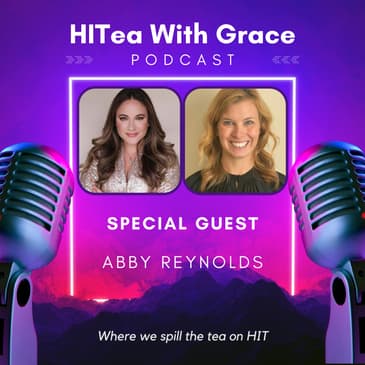
Today, I’m thrilled to welcome Abby Reynolds, Chief Experience Officer at Pleio (that’s Play-oh!), to dive deep into what it takes to create emotional bonds that inspire patients toward better health. Abby, thanks for joining us today!
We'll explore Abby’s path to Pleio, insights into how pharma can best address emotional burdens impacting adherence, and the power of personalizing patient experiences. From peer-to-patient programs to resources like rebates and educational support, Abby will share what really makes a difference in helping patients stick with their treatments.
Plus, we'll look ahead at how pharma can elevate direct-to-consumer engagement in 2025, and how the rise of GLP-1s might shape the human-first approach to patient care.
So, grab your tea and get ready for some real talk on patient experience, empathy, and why pharma should care.
[00:00:04] Welcome to the High Tea with Grace podcast, where we spill the tea on HIT. Today, I'm honored to welcome Abby Reynolds, Chief Experience Officer of Playo. Thanks for joining us today, Abby.
[00:00:16] Hi, Grace. Thanks for having me. Happy to be here.
[00:00:18] So tell me about the career path that brought you to Playo. And what does Playo mean?
[00:00:23] Playo actually means many or more. It was a name that came about when they founded the company. And it's interesting because most people can't say it.
[00:00:33] You get the E-I-O in there and you get everything from Playo to... We usually say Play-Doh like Play-Doh, however you want to think about it.
[00:00:43] But we say more or many because we feel like patients need more or many when you look at the types of patient support that patients benefit most from.
[00:00:51] As far as my career path, really, it dates all the way back to my family had a family owned jewelry store in North Central West Virginia.
[00:01:03] And in the attic at one point, who knows when in the early 1900s, I'm guessing it was a pharmacy.
[00:01:10] And so we would actually go up in the attic when we were at work with dad and play pharmacy, which I had no idea what that meant.
[00:01:17] But there were bottles and papers and documents and obviously well before HIPAA.
[00:01:23] And so we would go up there and we would play just like you play house or school, we play pharmacy.
[00:01:26] But I knew all along going into going to college that my focus was going to be on helping people.
[00:01:32] That's what's always been my passion. That's what makes me happiest.
[00:01:36] And so I wanted to choose a career path that would allow me the opportunity to do that on a regular basis.
[00:01:41] And so I went to pharmacy school and quickly found that, again, I wanted to be patient facing, not just dispensing, but helping people on a regular basis in a more comprehensive way.
[00:01:51] And so I looked to do that by doing a community practice residency with the University of North Carolina in Car Drug in North Carolina.
[00:01:58] So that was the partnership that I was able to participate in.
[00:02:03] I successfully completed the residency and then stuck around with Car Drug, which was a phenomenal, very innovative pharmacy chain in the North and South Carolina area at the time.
[00:02:14] And I ran one of their pharmacists run health care centers.
[00:02:17] And from there, eventually went to the corporate office and managed clinical programs as a whole for Car Drug.
[00:02:23] And then interestingly enough, one of the programs I managed was the Good Start program, which is Playo's Cornerstone program.
[00:02:29] So I almost feel like Playo fell into my lap, I guess you could say, by virtue of the programs that I was supporting for the pharmacy at the time.
[00:02:38] And after several years managing clinical programs, I decided I wanted to join the Playo team.
[00:02:43] And so about 12 years ago at this point, I joined the Playo team and my roles have evolved, but always been primarily focused on how to support patients the best possible way that we can.
[00:02:54] What a critical mission.
[00:02:55] I think it's really important when we work in this space to really think about what is our mission, right?
[00:03:01] It's not just a job when you're working in health care and pharma IT.
[00:03:05] It is a mission.
[00:03:06] And so just wanting to improve the lives of people is honorable and is, I think, the best kind of mission you can have here.
[00:03:12] So tell me, how can pharma best address the emotional burdens for patients who might otherwise be unlikely to adhere to recommended therapy because of their fear, sadness, confusion?
[00:03:24] I hear you're an expert on this.
[00:03:26] That's an interesting question.
[00:03:28] And if you look at a lot of the literature that's out there around adherence, there was a recent article publication by the American Medical Association,
[00:03:36] and it found that five of the eight major barriers to adherence are emotional in nature.
[00:03:41] And so we can do all the things we want to do to help put the medication in that patient's hands.
[00:03:46] But if we can't help them overcome those emotional burdens, those emotions that would prevent them from being successful on treatment,
[00:03:54] they're still not going to ultimately have success.
[00:03:57] And so the ways in which we can do that, there's a lot of different approaches.
[00:04:00] We have always felt that the most impactful approach is being patient-centric, recognizing that patients are people.
[00:04:07] How do you communicate to someone in such a way that you can establish rapport?
[00:04:12] You can feel supported, motivated, want to do the right thing, and ultimately drive a behavior change to follow your treatment regimen,
[00:04:21] follow your prescribed medication, follow whatever big, small that looks like to you.
[00:04:26] How can you be the most successful?
[00:04:29] And I think there are a lot of things that you need to consider in how best to address those emotional burdens,
[00:04:36] but a lot of it can be done through a relationship or supporting the patient in a different type of capacity,
[00:04:42] supporting their emotional needs while all the while providing access to helpful information and resources that they may need.
[00:04:49] What do you think is the most important aspect for the industry to consider when it comes to personalizing that patient experience?
[00:04:56] How do they put the patient in the center?
[00:04:59] And when historically people have said, oh, we're patient-centric, but they really haven't.
[00:05:04] And so what is important for people to consider?
[00:05:06] No two people are alike.
[00:05:08] No matter how outwardly alike they may appear from a socioeconomic status, gender, religion, you name it.
[00:05:16] Even if you match people, there are still many differences.
[00:05:19] So understanding patient-centricity, that you have to be able to tailor those messages to meet the needs of the patient.
[00:05:26] What I need to feel supported might not be what you need to feel supported, and there's nothing wrong with that.
[00:05:31] So helping to identify what those barriers are specific to each individual patient and then supporting them thereafter.
[00:05:38] And that can be anything from the emotional barriers like stigma.
[00:05:43] Maybe when you talk about GLP-1s, for example, in the weight management category, for so long we've lived in this society where if you can't lose weight, you must not be eating right or you must not be exercising.
[00:05:55] But in the grand scheme of things, you can be doing all the right things and still need additional support by virtue of a medication like a GLP-1.
[00:06:03] And I point those out specifically because they have a lot of emotional burdens associated with them.
[00:06:08] It might be the first time that patient's injecting a medication.
[00:06:11] So now I'm scared.
[00:06:12] I actually have to stop with this to have success.
[00:06:15] What does that look like?
[00:06:17] What if I forget a step?
[00:06:19] What are my friends going to think if they know I'm taking this?
[00:06:22] GLP-1s are a great example.
[00:06:24] Mental health is another example where there's a lot of stigma associated with different disease states.
[00:06:28] And a lot of it is understanding where that patient's at.
[00:06:33] Information in a way that's health literate.
[00:06:36] You don't want to communicate to someone in a way that they feel that they're being talked down to.
[00:06:40] You want to communicate in a way that seems meaningful and like you're sharing information, you're sharing knowledge, and you're sharing support.
[00:06:46] So meeting that patient where they're at, I would say, is very important.
[00:06:49] But then also tailoring the information to meet the patient's needs.
[00:06:53] So interesting to hear about this emotional bond that's critical and emotional intelligence is critical to adherence.
[00:07:01] And I don't think the industry is really understanding that to the extreme that you're really propagating here.
[00:07:07] Do you feel that peer-to-peer programs could be helpful with that?
[00:07:11] Kind of helping with that emotional bond with confidence, trust, adherence.
[00:07:16] What do you feel is critical to making sure that emotional bond is considered?
[00:07:21] Absolutely. I think peer-to-patient programs are a tremendous way to approach this.
[00:07:27] As a pharmacist myself, I've done a lot of diabetes education.
[00:07:31] And I know that even though I can sit there and teach someone how to check their blood sugar, how to inject their insulin,
[00:07:38] I also know that when they get home, I'm still viewed as a healthcare professional.
[00:07:42] And I say that. I'm incredibly proud to be a pharmacist and a healthcare professional.
[00:07:46] But I also recognize that when it comes to emotional barriers, I might not be the best fit for addressing that.
[00:07:53] So when you talk about peer-to-patient programs, that's exactly what that would be.
[00:07:57] So taking a peer, someone who is intentionally not a healthcare professional, arming them with all the skills and soft skills that they would need to be successful in conversating or supporting a patient.
[00:08:09] So things like empathy, being able to understand where a patient's at and convey that back to them so they feel that level of support is huge.
[00:08:17] I also think that when you look at a peer-to-patient program, it is human first.
[00:08:22] And when you think about how you feel best supported in a time of need, when you're feeling down, more often than not, unless it's from a loved one, it's not coming in a digital form.
[00:08:33] It's coming from a hug.
[00:08:34] It's coming from your friend stopping by and saying, hey, you've got this.
[00:08:38] And so a peer-to-patient program can pull those parts and pieces together and help that patient feel supported and help them digest that information that they've been given, likely by a healthcare professional, in digestible pieces.
[00:08:52] Open those receptors so that they can really start to accept that information and put it to use.
[00:08:58] Very interesting.
[00:08:59] So how does PlayOp incorporate all of that together with tech and then personalization and then peer-to-peer?
[00:09:06] How do you fit those things together and mold them together there?
[00:09:09] Yes.
[00:09:10] And they're all very important parts and pieces to pull together.
[00:09:13] And so what we've done at PlayOp is our cornerstone program is known as the Good Start program.
[00:09:18] And it's multi-tactic.
[00:09:20] So we recognize, again, that human first, the need for human first, the need for the peer-to-patient component.
[00:09:26] But we also pull in those digital pieces too.
[00:09:29] How can AI make our humans smarter?
[00:09:31] How can we pick up on the tone and sentiment in conversations?
[00:09:34] How can we best determine what a patient's journey may need?
[00:09:38] And so you work, you pull from some of the tech pieces to make the human part smarter, to make that patient-centric part smarter.
[00:09:46] And so in having a multi-tactic program, that can look like live phone conversations.
[00:09:51] That can look like text messages, emails.
[00:09:53] And it can look like options for various relations, like RM-type programs, where it's a longer-term adherence play that the pharma company may offer.
[00:10:03] But ultimately, at PlayOp, we feel so strongly about that human first component.
[00:10:07] Because we know if you don't introduce, if you don't start with the human to introduce the digital, the patient doesn't necessarily understand the value in the digital, what they're getting from it.
[00:10:18] And if you think about it, you can apply this to real life.
[00:10:21] If you start getting bombarded by text messages that you didn't sign up for, or you didn't know you were going to get, if you're anything like me, the first thing I do is text stop.
[00:10:30] Like, I didn't ask for these.
[00:10:31] I don't want them.
[00:10:32] I don't know why you're sending these things to me.
[00:10:34] Versus if I can explain to you, hey, Grace, would you be interested in this?
[00:10:38] I think based on what you're telling me, it would be a great fit.
[00:10:40] You should check it out.
[00:10:41] You can find recipes or patient testimonials or you name it.
[00:10:45] And I think you'd love that.
[00:10:47] Then when I send you that link, oh, this is what Abby was telling me about.
[00:10:50] I need to go check this out.
[00:10:51] So you pull all those parts and pieces together and then you can deploy them in a way that's meaningful to the patient.
[00:10:57] So interesting.
[00:10:58] And I love this whole concept of helping them create that emotional connection and then getting them information that's really useful to them.
[00:11:06] Do you find that sending them insights on rebates, coupons, educational materials helps them and really empowers them with knowledge that they need to be adherent as well?
[00:11:17] Absolutely.
[00:11:18] The savings and co-pay assistance, patient assistance programs, they're all critical to the patient's success.
[00:11:25] Those are really what we refer to more as mechanical barriers to adherence.
[00:11:29] So gaining that access piece to the medication, you have to be able to access the medication before you can successfully take it, of course.
[00:11:36] And so we do offer those types of resources within our programs and patients do find value in them.
[00:11:42] But then you also have patients who, you know, so long as that savings card is applicable and they're eligible to continue using it, they stay on therapy.
[00:11:52] But maybe when that goes away, that changes.
[00:11:55] And so ultimately pairing the mechanical support like a savings card or patient assistance program with that more holistic human first support will drive not only the access component with the savings, but the, I would say, more of a behavior change, a holistic change in that patient.
[00:12:14] And so those are very important components, but I wouldn't say that they make up the most important part in my opinion.
[00:12:22] Absolutely.
[00:12:22] That makes a lot of sense.
[00:12:24] So when we're looking to the future of this space, what do you hope that pharma companies really start to do when it comes to prioritizing direct-to-consumer engagement?
[00:12:37] What are the things that you hope to come in the next 5 to 10 years?
[00:12:41] Sure.
[00:12:41] For me, simpler is better.
[00:12:44] Recognizing, again, that patients are people.
[00:12:47] I think as pharma companies prioritize that direct-to-consumer engagement in 2025 and even beyond, there really needs to be a focus on building trust and authentic relationships with patients rather than just a push of information, trying to sell a product.
[00:13:02] That shift really, it requires a deep understanding of the patient's journey.
[00:13:06] And that can include emotional, psychological landscape, whatever it is, those are critical to fostering that genuine patient engagement and loyalty.
[00:13:16] Pharma needs to consider how not only how it can meet patients where they're at, but then once you've met them, what can you do to support them?
[00:13:26] How can you best tailor that?
[00:13:27] It comes back to tailoring to the needs of the patient, making that complex medical information accessible, but ultimately in supporting patients and making them feel empowered and make informed decisions.
[00:13:43] So interesting.
[00:13:44] What areas do you feel could be the most impacted by this type of program or are right now or really could be?
[00:13:51] Do you feel like it's chronic condition management?
[00:13:53] What kinds of drugs and what kinds of specialties do you feel have the most impact here?
[00:13:59] At Pleia, we've supported maybe, I would say, more than 30 different chronic disease states at this point.
[00:14:05] So we've supported everything from what you would consider your basic chronic conditions like high blood pressure, high cholesterol, to things that are much more specific.
[00:14:15] So more like a specialty medication you can think about.
[00:14:18] And what we found is that regardless of the complexity or how we perceive the complexity of therapy, the patients still need emotional support.
[00:14:27] And so we've had great success across the board, regardless of disease state, because again, just taking it back, peeling back the layers of the onion to the core, we're human.
[00:14:38] And so looking at that, and there are certain nuances, of course, based on different disease states, whether it's a complex delivery device or an injection, or I've been a healthy human my whole life and I've never had to take medicine.
[00:14:52] And now I can't remember how do I weave that into my daily routine?
[00:14:55] And so I think when you say which types of disease states, I really don't think that there's anything that wouldn't be fair game.
[00:15:04] I don't know of any disease state where a patient doesn't have some sort of support need.
[00:15:09] It seems like a lot of patients to get that support are going to Facebook and going to other areas.
[00:15:16] And yet a lot of misinformation is spread in those types of areas.
[00:15:23] So do you feel that having that information that's specifically targeted to what they have and then having them connect with others and being able to monitor helps support that a little bit without having to worry about misinformation?
[00:15:38] I'm just wondering, what are your thoughts on that?
[00:15:40] I think misinformation is a big problem in today's world, obviously, across the board, not just in the healthcare space.
[00:15:48] But naturally, we're curious.
[00:15:50] The first thing I do personally, whenever I get a new prescription or be at a diagnosis or have a question is, what do you do?
[00:15:59] You Google it.
[00:16:00] Or in the case you have access to more sophisticated resources, you would utilize those.
[00:16:05] But it's our natural instinct to want to collect more information, to want to connect with people who are like us.
[00:16:10] I think it is important to make sure that information that patients are accessing is credible.
[00:16:18] That's something we take very seriously, at least with respect to our programs, is the types of information we're providing is at a readability level that can even be understood.
[00:16:27] Those are all very important parts to consider.
[00:16:30] And unfortunately, I don't know that misinformation is going away anytime soon.
[00:16:34] So I think, again, that just really highlights the need for patient support that pharma can drive.
[00:16:40] So that way, we know that patients are getting the types of support or have access to the types of support that they would find most beneficial.
[00:16:47] Because they're going to do that no matter what.
[00:16:49] So why not also have something to help maybe them navigate through?
[00:16:54] Exactly.
[00:16:55] What they're getting.
[00:16:55] Exactly.
[00:16:56] Very interesting.
[00:16:57] Our listeners really like to get to know what's going on in the industry.
[00:17:01] And I appreciate you sharing your knowledge and perspective so generously.
[00:17:05] They also want to get to know you as a leader.
[00:17:08] Tell me, you're a chief experience officer at a company.
[00:17:12] What are things that you do in your daily life that help you work your best and make a difference and just be your best self at work?
[00:17:19] Yes, absolutely.
[00:17:21] There are several things that I like to do regularly.
[00:17:23] Spending time with my family is huge.
[00:17:26] That always refills my pot, so to speak.
[00:17:29] I think that it's important for everyone to have some level of support, family, friends.
[00:17:35] That's definitely one of the most important things in my life.
[00:17:38] I also enjoy working out.
[00:17:39] That's my mental health.
[00:17:40] That's what I do to check that box every day.
[00:17:43] I find a lot of benefit in the way that it makes me feel mentally.
[00:17:47] It helps clear my head.
[00:17:48] It gives me dedicated time to not think or focus on anything that's too challenging.
[00:17:54] But ultimately, what makes me happiest is helping others.
[00:17:57] I have always found just been so passionate about helping others.
[00:18:02] I'm a true middle child.
[00:18:03] I feel like I was born agreeing, like, where do you want to go to dinner?
[00:18:08] That was never necessarily my choice.
[00:18:10] I go with whoever picked what and went that way.
[00:18:14] But over time, I've learned to speak up, not necessarily just go with the flow.
[00:18:19] But what I'm trying to say is, in being a middle child, I've always aimed to please.
[00:18:23] I've always wanted to help.
[00:18:24] I've always found passion in helping people and always been an empath almost to a fault.
[00:18:31] I will...
[00:18:32] You can tell me something and I internalize it to the degree that I'm like, wait a minute.
[00:18:36] Hold on.
[00:18:36] This isn't even me.
[00:18:37] How can I support that person?
[00:18:39] This isn't me.
[00:18:40] This is them.
[00:18:40] But what can I do?
[00:18:41] And I think that ultimately, that drives who I am in the workplace because I want to create
[00:18:46] a patient experience that people find valuable and that supports patients in a way that they
[00:18:53] may not have otherwise.
[00:18:54] I think that's such an amazing perspective to have, to see that as your superpower.
[00:18:58] Because I think sometimes we look at our strengths, the things that make us amazingly awesome,
[00:19:04] but just see how it may impact us negatively and try to push those things down.
[00:19:08] No.
[00:19:09] Whatever makes you unique is amazing.
[00:19:13] And you should really get into that because that's who you are.
[00:19:15] That's your superpower.
[00:19:17] Yes.
[00:19:18] In our life, we are constantly faced with struggles and challenges and things that are just
[00:19:23] thrown in our direction and throw us off.
[00:19:26] What are things that you have done in your life to help you overcome challenges that come
[00:19:32] your way?
[00:19:33] I've always found that taking things one step at a time is very helpful.
[00:19:37] I don't remember the exact...
[00:19:38] How do you eat an elephant?
[00:19:39] That quote, what is it?
[00:19:40] One bite at a time or something like that.
[00:19:42] I think that's how it goes.
[00:19:44] I don't even know.
[00:19:45] But you know what I'm trying to say.
[00:19:46] Oh, absolutely.
[00:19:47] How do you eat an elephant?
[00:19:48] One bite at a time.
[00:19:49] It's such a helpful thing.
[00:19:51] And it's almost oversimplified.
[00:19:55] But truly, if you look at the problem as one big problem, then you're going to sit there
[00:20:00] and think, how do I address this?
[00:20:02] Start with the things.
[00:20:02] Start with the small bites.
[00:20:04] And then you'll progress further and further.
[00:20:07] I think it's important to learn from your challenges too.
[00:20:10] That's one of the things that makes us who we are.
[00:20:12] We all have challenges throughout our lives that help us become better people.
[00:20:18] And so I try anytime there's a problem or a challenge to really put that into context.
[00:20:25] You can do this.
[00:20:27] You've done hard things.
[00:20:28] We can all do hard things.
[00:20:29] So take those baby steps, move it forward.
[00:20:32] And then you'll be able to look back and learn from it.
[00:20:35] Be proud of it.
[00:20:36] Maybe not be proud of it, but still learn from it and keep moving forward.
[00:20:41] So true.
[00:20:41] And so encouraging for all of us.
[00:20:43] One step at a time, guys.
[00:20:44] One bite of elephant at a time.
[00:20:47] So I'm wondering if you could give your younger self a piece of advice,
[00:20:52] what would that be?
[00:20:53] And I'd like to start with career advice and then just personal life advice.
[00:20:58] Let's see.
[00:20:59] I would say go for it.
[00:21:00] You're capable of more than you believe.
[00:21:02] I think when you look back at the things that we do,
[00:21:05] even yesterday, a month ago, a year ago,
[00:21:08] sometimes it's, wow, I did that.
[00:21:10] That's cool.
[00:21:11] And so encourage yourself.
[00:21:13] Be your best.
[00:21:14] Be your biggest cheerleader.
[00:21:15] I would say that's important too.
[00:21:18] There's always good and bad days.
[00:21:20] Learn from them.
[00:21:21] What made this day good that you can apply to the bad days to make them better?
[00:21:24] And ultimately look at the big picture.
[00:21:27] Don't get caught up in the nuances of the details and the day-to-day.
[00:21:30] What are your goals and what is your path to get there?
[00:21:34] And recognize that at times it may be bumpy,
[00:21:37] at times it may be smooth sailing, but keep pushing.
[00:21:39] Go for it.
[00:21:40] I love that.
[00:21:41] And then from a...
[00:21:42] Yeah.
[00:21:43] And from your personal perspective too, I'm interested.
[00:21:45] Yeah.
[00:21:45] Yeah.
[00:21:46] Personal perspective.
[00:21:47] I think it's important to treat others as you would wish to be treated always.
[00:21:51] I think it's important to put yourself in the other person's shoes.
[00:21:56] So recognizing that what makes you happy might not make someone else happy,
[00:22:00] that what upsets you might not upset someone else,
[00:22:03] and that we're all very different.
[00:22:05] And so recognition of that and loving everyone as yourself,
[00:22:10] I think is probably the biggest piece of advice that I would give.
[00:22:12] Yes to that.
[00:22:14] Yes to that.
[00:22:15] And if there was more of that in the world, we would be living in a better world.
[00:22:20] We would all be so much happier.
[00:22:22] Absolutely.
[00:22:23] And just work better together.
[00:22:25] And I think it's just critically important.
[00:22:27] So to finish this conversation off, where can our listeners find you online?
[00:22:31] Several different places.
[00:22:32] You can find me on the Playo website.
[00:22:35] So P-L-E-I-O.
[00:22:37] You can sing it like B-I-N-G-O.
[00:22:39] If you need a way to remember that.
[00:22:40] And then LinkedIn, I'm also there.
[00:22:44] So feel free to reach out.
[00:22:47] Love to meet new people.
[00:22:48] Connect.
[00:22:49] Learn about others' experiences for sure.
[00:22:51] That's terrific.
[00:22:52] Now, before I forget, did you happen to bring tea with you today?
[00:22:56] I sure did.
[00:22:57] Tell me about your mug.
[00:22:58] It looks beautiful.
[00:23:00] It's a mug from a local potter in North Carolina.
[00:23:04] North Carolina is known in certain parts for their pottery.
[00:23:07] But I specifically chose that one because it reminds me of a close family friend who is a mentor of mine who helped get me to where I am today.
[00:23:17] And who plays a very important role in my everyday life.
[00:23:23] I find myself asking or in a pickle, what would this person do?
[00:23:27] And so I like to look at that mug and think about where I've been, where I'm going, where I am now and really reflect on that.
[00:23:35] That's too great.
[00:23:36] Thank you so much for joining us today, Abby.
[00:23:38] We love to learn from you.
[00:23:39] Thank you for having me, Grace.
[00:23:40] This has been great.
[00:23:42] And thanks to you folks for joining us too.
[00:23:44] Check out the Hi Tea with Grace podcast for more interviews with great guests like Abby today.
[00:23:49] Cheers!
[00:23:50] Like a Girl Media is more than a media network.
[00:23:52] It's a community.
[00:23:54] We want to meet you and amplify your voice and the voices of outstanding women innovating in healthcare.
[00:24:00] Interested in starting your own podcast or hosting an event near you?
[00:24:04] Connect with us online or in person.
[00:24:06] We're here to support and empower you.
[00:24:08] Thank you.
[00:24:09] Thank you.